Insights

Insight Innealla · 6 min read

Why we built our own student information system.

About five years ago, alongside the student systems we already support for colleges, we started building our own. Innealla is the result: one student record from application to transcript, built for colleges in Ireland and the UK and run by the people who support it.

SG
By Stephen GrayDirector, Inneall
6 min read
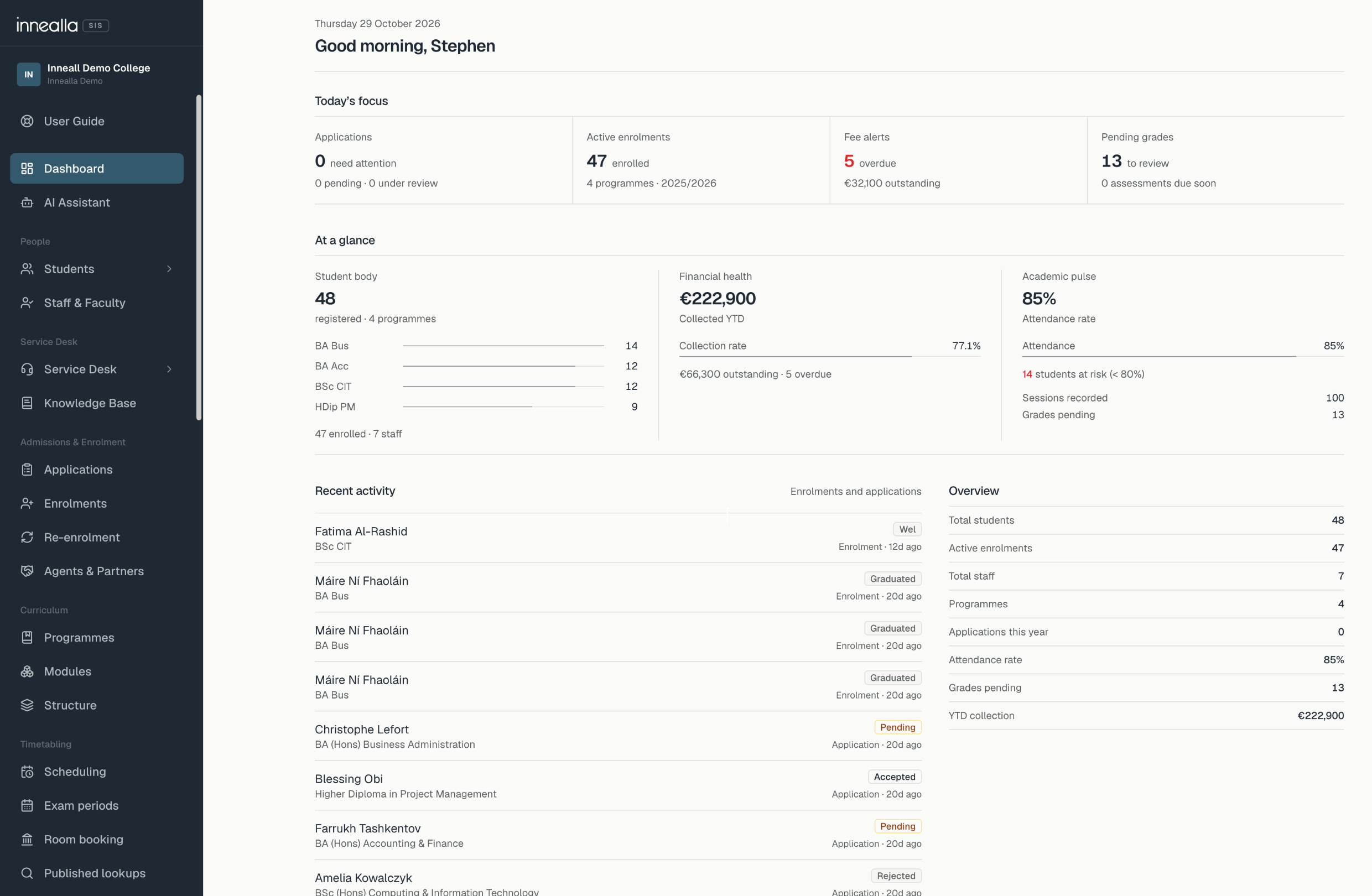
The Innealla dashboard for a demo college, showing applications, enrolments, fee alerts, pending grades, financial health and attendance

The Innealla dashboard, shown with sample data from the demo college.

What we kept seeing.

For years we have worked with higher education and professional training providers on their Moodle estates, CRM, integrations and student services. Across those colleges, we kept seeing the same pattern.

The student operation was spread across tools that did not talk to each other. A legacy student system had been bent to fit Irish processes it was never designed for. Staff re-keyed the same student into admissions, finance and the VLE, and a simple management question took days of exports and spreadsheets to answer.

Integrations broke whenever a third-party system changed, and getting a supplier to change anything was slow or impossible. Often we were the team building the missing pieces: the connector, the report, the workaround that kept term running.

That work keeps colleges going, and it is still a core part of what we do. But for some colleges, we could see that the answer was a student record designed from the start around how they work.

The decision to build our own.

About five years ago we decided to invest in building our own student information system, alongside the integration and support work we already do on the systems colleges run today.

We were in a better position than most to do it. We already build and run Moodle estates, a Salesforce managed app and connectors for colleges, so integration has been part of Innealla from the start, not an add-on after launch. We also knew, from years of support work, exactly where student systems let colleges down.

It was not a small decision. Building a student information system means owning the record that registry, finance and academic staff depend on every day, and standing behind it for years.
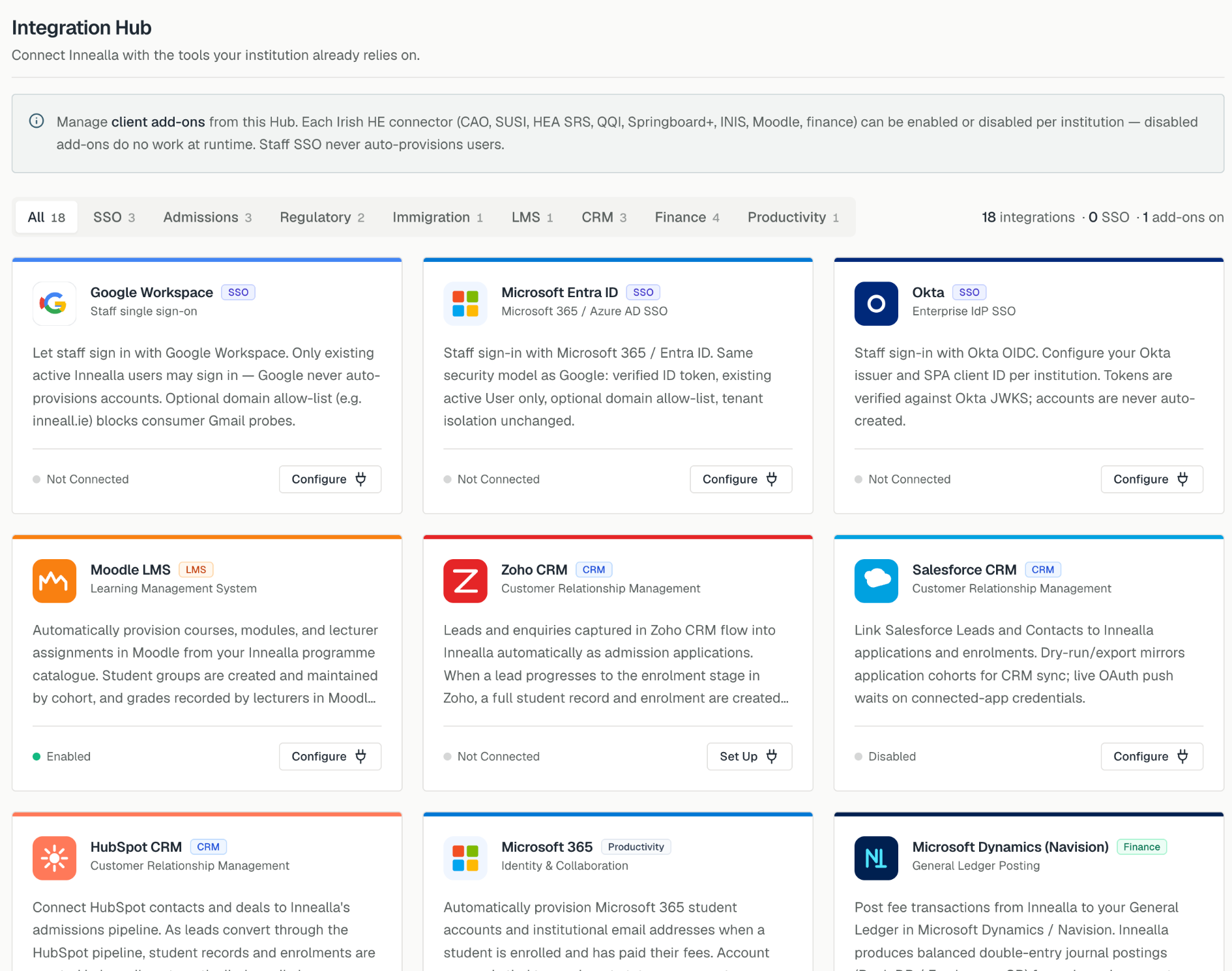
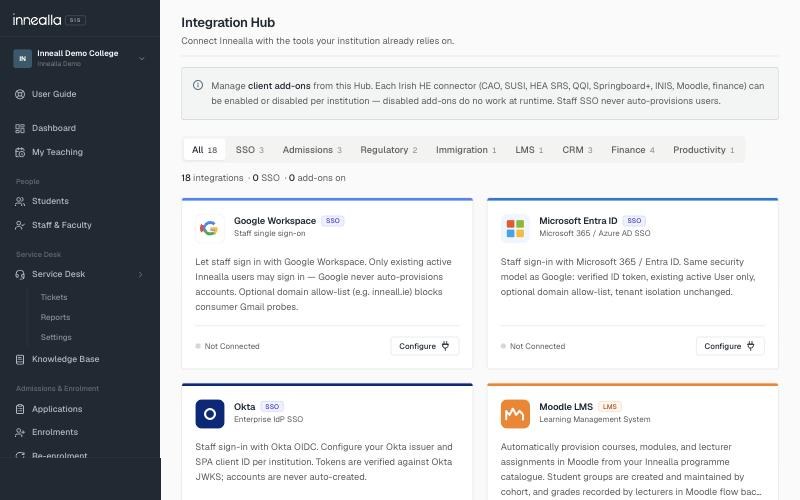
The Integration Hub in Innealla, with connectors for Google Workspace, Microsoft Entra ID, Okta, Moodle, Zoho, Salesforce, HubSpot, Microsoft 365 and Microsoft Dynamics
The Integration Hub. Moodle, CRM, single sign-on, finance and Irish regulatory connectors, each switched on per college.

We set five principles at the start, and they have shaped every decision since.

01

One student record, one data model.

Change it once and everything that depends on it follows.

02

Built for Irish and UK processes.

QQI exports, CAO, SUSI, HEA returns, Springboard+ and immigration attendance reporting built in, not bolted on.

03

Built and run by the people who support it.

No hand-off between a vendor and a reseller.

04

AI built in, inside your permissions.

Staff ask questions and give instructions in plain English against the live record.

05

Pricing you can plan around.

A subscription banded by student numbers, with the rate held for 24 months.

Built alongside colleges.

We did not design Innealla in isolation. It was shaped with colleges we already work with, through requirements workshops, demos, Q&A sessions with registry, finance and IT staff, and a feedback loop on every module.

Real processes set the priorities: how a college structures its programmes, modules and intakes, how fees, instalments and sponsors actually work, how assessment boards sign off results, and how a timetable changes in week three. Each module was built around the way colleges in Ireland and the UK already run, rather than asking them to change to suit the software. When a screen did not match how a registry office works in the middle of enrolment, it went back on the board until it did.
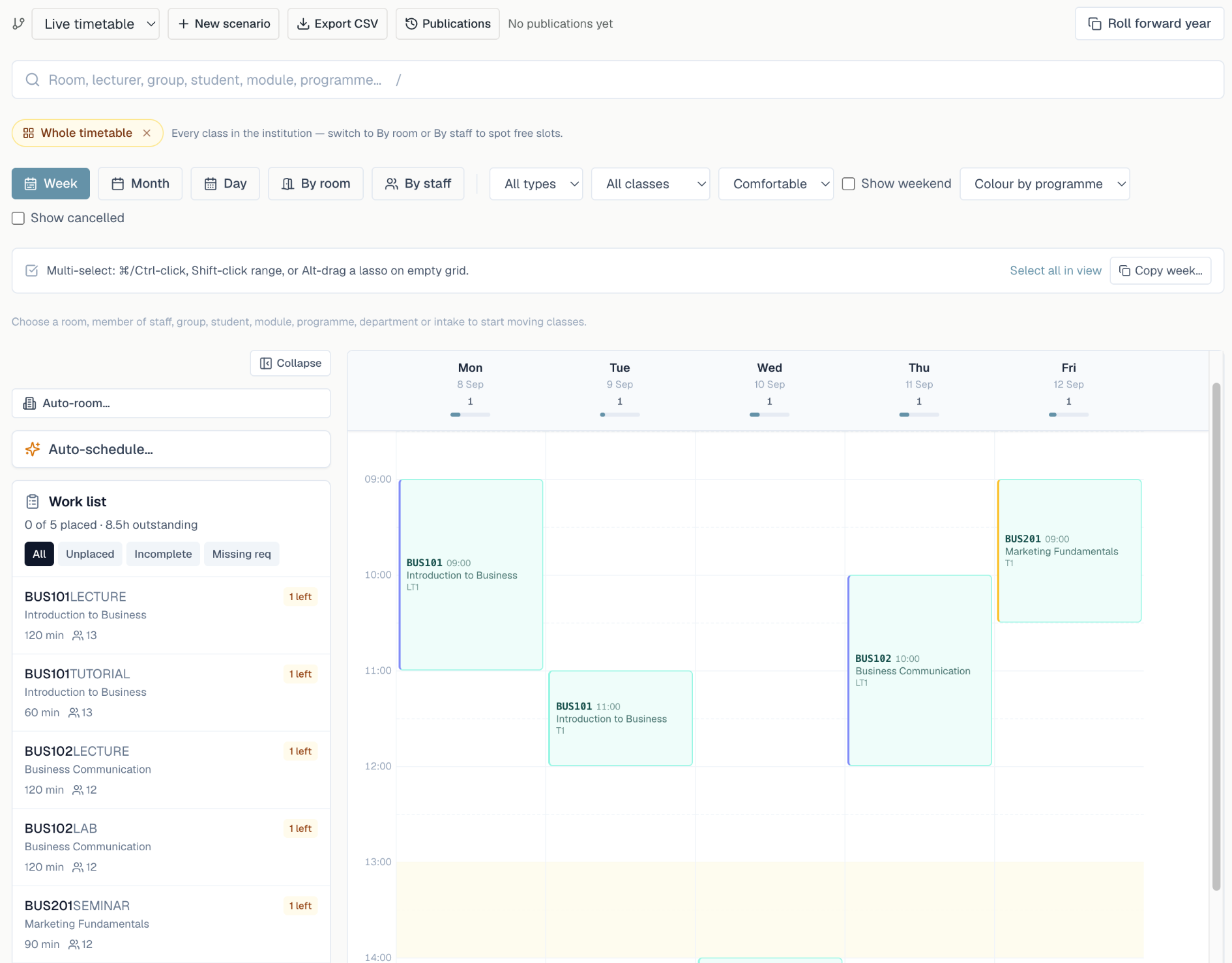
The Innealla scheduling workbench, showing a week view of classes, a work list of unplaced classes and planning scenario controls
The scheduling workbench. Work on a planning scenario alongside the live timetable, then publish when it is ready. Sample data.

What Innealla is today.

Innealla is a cloud student information system that holds one student record from first application to alumni. Change a module start date and the timetable, the enrolments and the student’s portal all follow, without anyone re-keying it. The full detail is on the Innealla page. Here is the short tour.

Student record, application to alumni.

Admissions with duplicate-person checks, curriculum, enrolments, attendance and assessment in one place, with early alerts for students at risk.

Finance built for Ireland.

Fee matrices, instalment plans, sponsor billing and holds on re-enrolment until fees are cleared.

Timetabling with planning scenarios.

Branch the live timetable, check for clashes, publish, and roll back if needed.

The AI brain.

Plain-English questions and instructions against the live record, within each person’s existing permissions.

Integration Hub.

Moodle, Salesforce, Zoho, HubSpot, Microsoft 365, Google Workspace, Okta and more, each switched on per college.

Student portal and mobile app.

A student portal and a branded mobile app, available as add-ons.
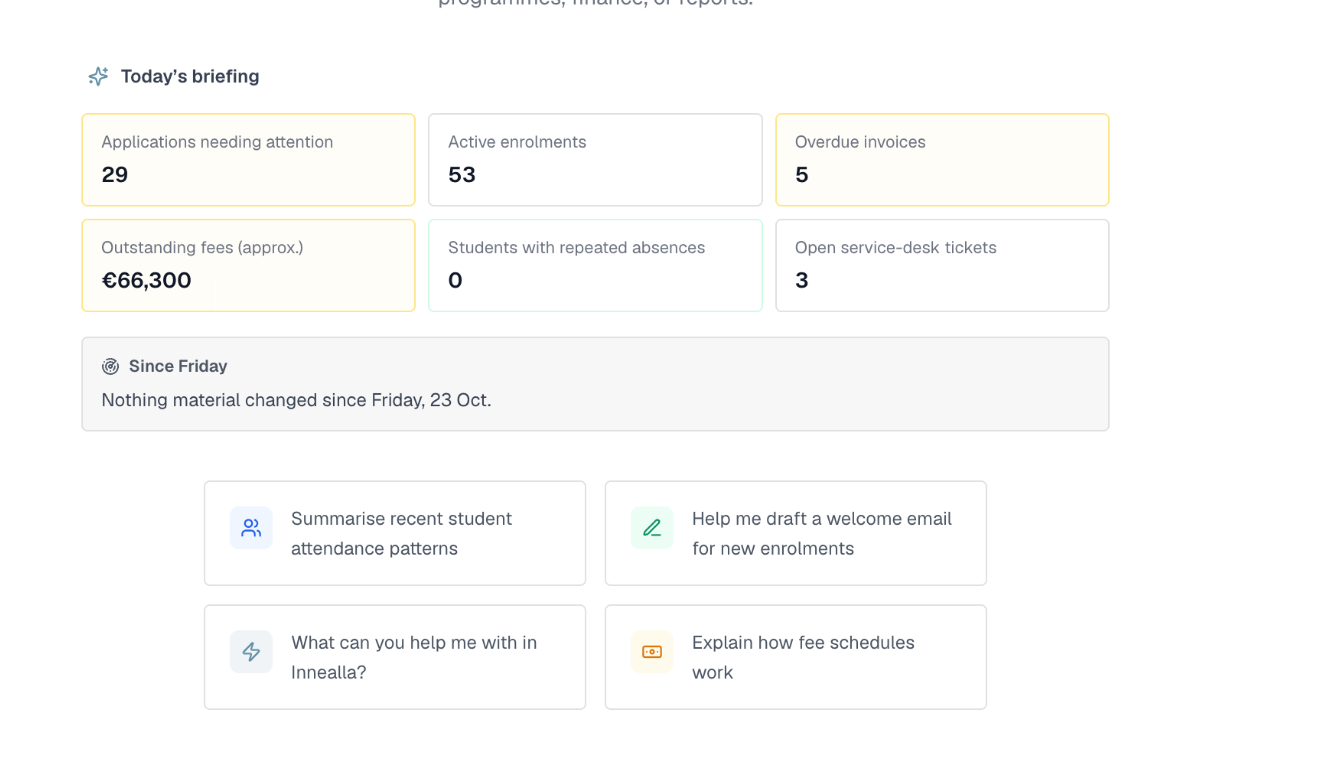
The Innealla AI assistant, with a daily briefing of applications, enrolments, overdue invoices and outstanding fees, and suggested questions
The AI brain. A daily briefing and plain-English questions against the live record, hosted in Ireland. Sample data.

Ask Innealla

Ask

“Which second-year students on the diploma are below 85% attendance and owe fees?”

Returns the list, with every figure traced to where it came from.

Tell

“Set up the September intakes from this spreadsheet.”

Comes back as a preview to approve before anything changes. Every request and action is logged against the person who made it.

Moving our own clients across first.

We are moving some of our existing clients onto Innealla first. We know their systems and their data, and we can stand behind the result, which makes them the right place to start.

Every move follows the same shape:

01

Discovery

Two weeks, fixed price. The data is graded A to G and the price is set.

02

Migration

AI-assisted, measured in days, not months.

03

Parallel run

Old and new systems run side by side before cutover.

04

Day one

Moodle and CRM reconnected from the first day.

Most colleges are live in under two months.

Because we already run these colleges’ Moodle and CRM, the connections are known before discovery starts, and the people doing the move are the same people the college already calls for support. As those colleges go live and agree to be named, we will share how the moves went.

The full process is set out in Moving off Banner, SITS or Quercus: what a SIS migration actually involves.

Who it is for.

  • Private and professional colleges in Ireland and the UK, from a few hundred students to several thousand.
  • Institutions replacing a departing supplier, a legacy SIS, or spreadsheets and local databases.
  • Groups with several schools or brands that want one platform with a separate instance for each.
  • Colleges already running Moodle or Salesforce with Inneall that want the student record connected.

What to do next.

The simplest next step is a demo built around how your college works. If it fits, a fixed-price discovery tells you the price and the go-live date before you commit to anything.

Step one

Book a demo

See Innealla working on your own processes.

Book a demo →

Step two

Book an Innealla Discovery

Know the price and the date before you commit.

Book a Discovery →
InneallaStudent information systemSIS migrationIreland and the UK

FAQ

Questions about Innealla.

Something else on your mind? Talk to us.

What is Innealla?

A cloud student information system built by Inneall for colleges in Ireland and the UK. It holds the student record from application to transcript, with a student portal, a mobile app and an AI brain built in. We host it, run it and support it ourselves.

Does this mean you no longer support other student systems?

We still support colleges on the systems they run today, and that will not change. Building our own gives colleges another option: a student record designed for Irish and UK processes, which we can develop and stand behind end to end.

How long does it take to move to Innealla?

Most colleges are live in under two months, starting with a two-week fixed-price discovery and finishing with a parallel run before cutover.

How is it priced?

A hosted subscription per college, banded by student numbers, with set-up as a fixed price confirmed at discovery and the rate held for 24 months.

Where is our data held?

In AWS in Ireland, with backups, monitoring and access controls, under a data processing agreement with every college.

Keep reading

Related insights.

All insights →

Innealla

See Innealla on your own processes.

A demo built around how your college works, then a fixed-price discovery so you know the price and the date before you commit.

Discovery, data grading, parallel run and cutover:
the stages every SIS migration goes through

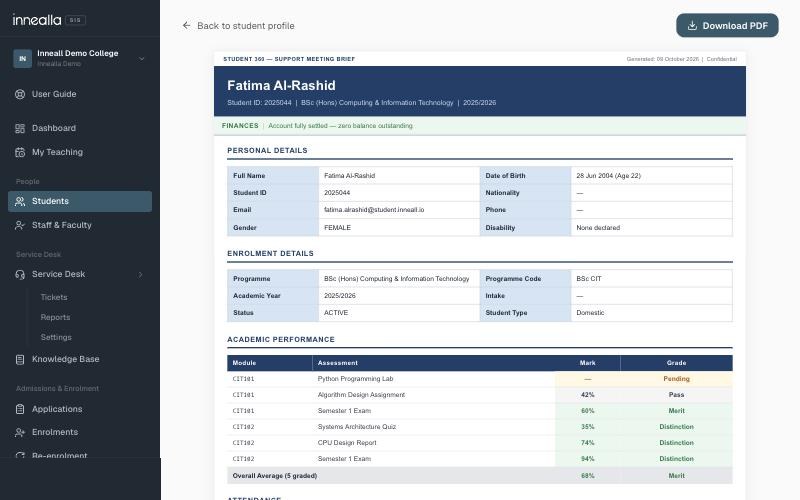
Innealla student 360 report showing enrolment, academic performance, attendance and fees for one student

Why colleges look at a move

Most conversations start with one of a handful of pressures. None of them is a criticism of Banner, SITS, Quercus or Colleague; they are the questions any college asks when a long contract comes up for renewal.

  • Cost: licence, hosting and change requests adding up faster than a smaller college can justify
  • Fit: Irish fee structures, QQI returns, instalment plans and sponsor billing handled through workarounds
  • Distance: a large supplier, a ticket queue and a release cycle that does not move with the academic year
  • Integration: Moodle, CRM, timetabling and finance each holding their own copy of the student
  • Reporting: management asking questions that need a developer or an export to Excel
Banner alternative

How a SIS migration actually works

Every move from Banner, SITS, Quercus or Colleague follows the same shape. Your current system stays the source of truth until cutover, and the numbers are proved before anyone switches off the old login.

  • Discovery: export assessment, data grades, fixed price and a go-live window timed to your academic calendar
  • Data grading: students, programmes, enrolments, results and fees mapped with every transformation logged
  • Parallel run: reconciliation reports your registry and finance teams can check side by side
  • Cutover: timed between intakes, with a written rollback plan
  • Day one: Moodle, CRM, finance and identity reconnected through the Integration Hub
See how we migrate to Innealla
Innealla Integration Hub with connectors for Moodle, Salesforce, Zoho, Microsoft 365, CAO, SUSI, HEA and QQI
strategic consulting

Discovery and data grading

The first two weeks are where risk is reduced. We grade the export before anyone commits to a price or a go-live date.

  • Export assessment from Banner, SITS, Quercus or Colleague
  • Data grades for students, programmes, modules, enrolments, results and fees
  • A fixed migration price and a go-live window before you commit
  • Clear list of what will migrate cleanly and what needs a decision
  • Rollback plan written before parallel run starts
SITS alternative

Who this kind of migration suits

A move is usually the right shape of project when the student operation is a few hundred to several thousand students and the college wants a system that fits Ireland and the UK, with Moodle and CRM connected from day one.

  • Private and professional colleges leaving a large enterprise SIS
  • Institutions renewing Banner, SITS, Quercus or Colleague contracts
  • Groups that want one platform with a separate instance per campus or brand
  • Colleges already on Moodle or Salesforce who want the student record connected
Explore SIS migration
AI & Intelligent automation

Parallel run, then cutover

Registry and finance check the numbers side by side before the old login is switched off. Cutover is timed between intakes, and the connectors that keep Moodle and CRM in step are part of day one, not a later project.

  • Reconciliation reports your teams can sign off
  • Cutover window agreed in discovery, usually between intakes
  • Written rollback plan if something does not match
  • Moodle enrolments and CRM applications reconnected through the Integration Hub
  • Finance, identity and messaging brought across with the student record
Quercus alternative

What to do next

If you are weighing a move off Banner, SITS, Quercus or Colleague, start with discovery. You get a graded view of your data, a fixed price and a go-live window before anything is committed. Read how SIS migration works, or go straight to the pages for Banner, SITS and Quercus.

Get in touch

Frequently Asked Questions

Which systems can you migrate from?
We regularly plan moves from Ellucian Banner, Tribal SITS, Quercus, Ellucian Colleague and spreadsheet-led operations. If yours is not on that list, discovery still grades the export and tells you what is possible.
How long does a migration take?
Most colleges are live in under two months after discovery, timed to the academic calendar. Complex multi-campus estates take longer; discovery sets the date before you commit.
What happens in discovery?
We assess the export, grade the data, agree a fixed migration price and a go-live window. You see what will migrate cleanly and what needs a decision before anything is committed.
Will Moodle and our CRM stay connected?
Yes. Enrolments, courses and CRM applications are reconnected through the Integration Hub as part of cutover, not as a later project.
What is the first step?
Talk to us, or start from the SIS migration page. A fixed-price discovery gives you a graded assessment of your data, a migration price and a go-live window.