Replacing Dispersed Student Data with a Student Information System Built for Growth

Insights / Case studies
Case study Chevron College
Replacing dispersed student data with a student information system built for growth.
How Chevron replaced scattered student spreadsheets with a student information system.
The Challenge
Spreadsheets Had to Go.
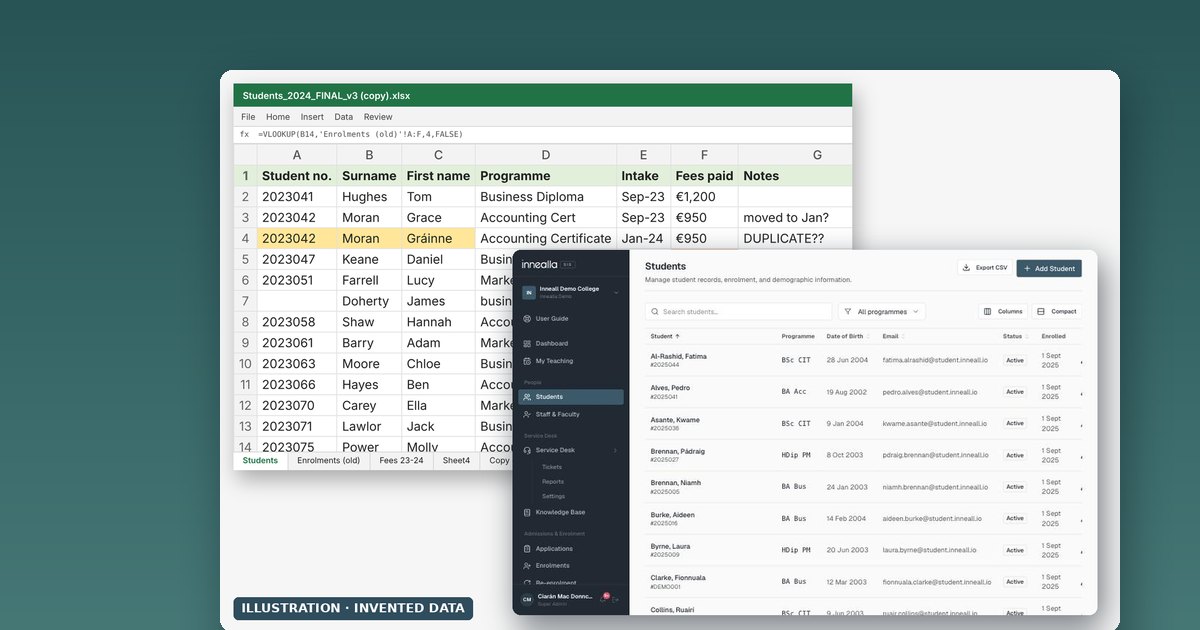
As Chevron College grew, the cracks in its data management began to show. Student records were being maintained in individually held Excel spreadsheets — each updated independently, each a potential source of duplication, inaccuracy, and conflict. There was no single source of truth. Getting a clear, reliable overview of student data at any given time was genuinely difficult.
The problem wasn’t just inconvenience. As student numbers increased, the college was becoming increasingly vulnerable to inaccurate communications with students, administrative errors, and a back-office experience that simply wasn’t fit for the institution’s ambitions. Chevron needed a system they could depend on — one that would grow with them, not hold them back.
Our Approach
Understanding the Journey First.
Before we recommended a single piece of technology, we worked closely with Chevron’s Director of Academic Affairs and Dean of Education to understand the full shape of the challenge. Through a structured journey workshop, we mapped the student lifecycle from first enquiry through to graduation, identifying where data was being collected, where it was being duplicated, where it was falling through the gaps, and where automation could make a real difference.
This upfront investment in understanding — rather than jumping straight to solutions — is central to how we work. It meant that when we recommended a technology direction, we did so with confidence that it would genuinely serve Chevron’s needs, not just tick boxes on a specification document.
The Solution
A Whole-System Approach.
We guided Chevron through the selection and implementation of a Student Information System (SIS) customised to meet their specific requirements — not an off-the-shelf product forced to fit, but a platform shaped around how Chevron actually works. We demonstrated the full possibilities: the manual tasks that could be eliminated with automation, the secure data collection and analysis capabilities, and the integrations with other platforms that would address different parts of the student experience.
The SIS didn’t stand alone. We integrated it with a new Customer Relationship Management system for recruitment and admissions, and with a replacement Learning Management System for course delivery. Together, these three platforms gave Chevron something it had never had before: a robust, joined-up technology ecosystem that changed how the college worked from the inside out.
The Outcome
Totally Connected, Fully Informed.
Today, Chevron’s operations teams run with a confidence and efficiency that simply wasn’t possible before. All student data is centralised — searchable, up to date, and consistent across every part of the organisation. Setting up new students is significantly faster. Enrolments are handled in one place. Administrative workload is down and errors are dramatically reduced.
The system also strengthened Chevron’s reporting and compliance processes, particularly around quality assurance and validation requirements — an area where accuracy and auditability matter enormously. And crucially, the architecture we put in place was designed to grow: every platform was chosen for its scalability, every integration built to accommodate expanding student numbers and course options.
Journey workshop
Mapping the student journey and business processes; defining data to be collected and efficiencies that could be gained.
Platform selection
Tech recommendations based on business and student requirements; aligned with the client’s timeline and budget expectations.
Multi-platform integration
SIS implementation and integration with a new Learning Management System, ensuring end-to-end insight and improvement of the whole student experience
Do you have preferred platforms you always recommend?
We know Moodle, Salesforce, Zoho, Sitefinity and Celcat well because they have proven themselves in colleges. We are not tied to any vendor. We start from what you need and what you already have, and we will tell you plainly if an existing platform is the right answer.
How long does a typical project take?
A focused integration or workflow automation can be live in weeks. A full programme across recruitment, student records, learning and reporting usually runs six to twelve months. Every project is broken into short phases so you see working software early and can change direction while it is still cheap to do so.
Where is our data held and how is it protected?
Systems we host run in AWS in Ireland, with backups, monitoring and access controls in place, and we can also run inside your own AWS or Azure account. We sign a data processing agreement with every client. We are working towards ISO/IEC 27001 certification and can share our security practices on request.
Can you help with the redesign of internal workflows?
Yes. Before we configure or build anything we sit with the people who do the work and map how it actually happens, not how the process document says it happens. We find the duplication and the friction, then design the workflow the technology will support. Better systems on broken processes do not give better outcomes.
Will off the shelf software meet all our needs?
Sometimes, rarely entirely. Established platforms are proven, maintainable and cost effective, but colleges have processes, compliance requirements and integrations that generic software does not cover out of the box. We use the platform where it fits and build the missing pieces where it does not, then connect everything so it works as one system.
More case studies
Keep reading.
A technology partnership at the heart of DBS's digital ambition
How Dublin Business School and Inneall grew a long-term technology partnership.
Read the case study →Taking BodySlims global
How BodySlims and Inneall built a mobile-first product partnership for global growth, with an iOS and Android app.
Read the case study →Lugh: the AI agent that answers our service desk first
An AI engineer with his own login, and a hard list of things he cannot do.
Read the case study →Talk to us
Want a partnership like this?
We are happy to start with a short call and no sales deck. Or begin with a fixed-price review of your Moodle, integrations or student systems.
