Integration First: Why Integration is the Backbone of Digital Transformation
Insights / Insight
Insight 2 min read
Integration First: Why Integration is the Backbone of Digital Transformation
Why colleges should connect the systems they already have before buying another platform.

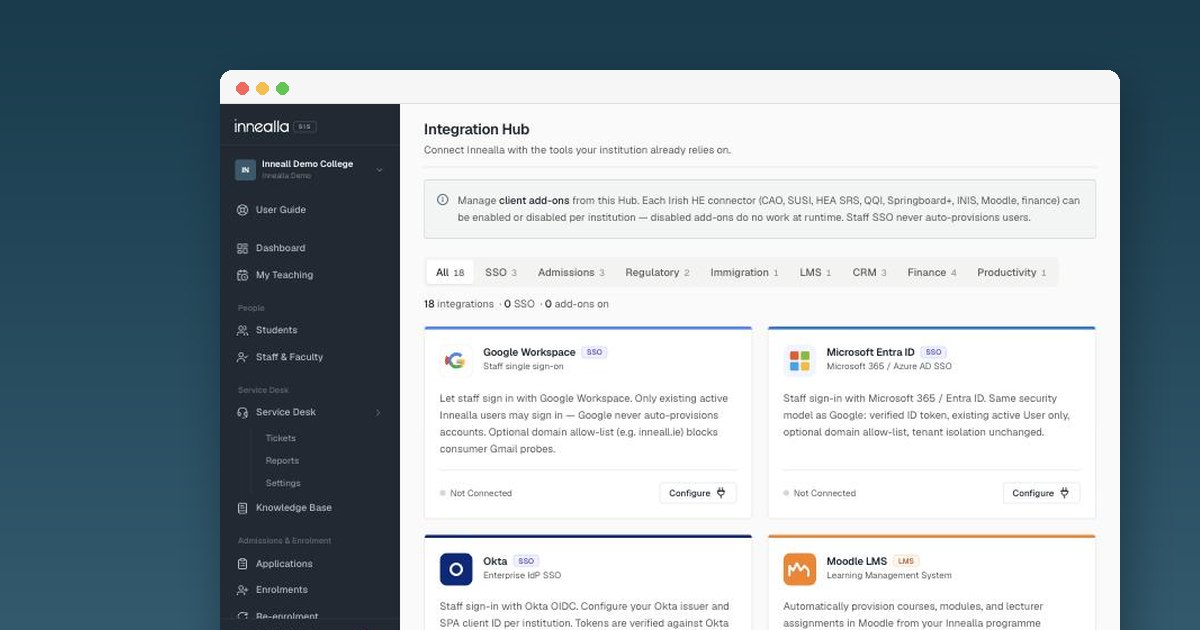
The Integration Hub in Innealla.
Ask most organisations about their digital transformation programme and they’ll talk about the platforms they’ve implemented: a new CRM, a refreshed website, a student information system, a learning management platform. What they talk about less — and what ultimately determines whether those investments deliver — is how those systems connect.
At Inneall, our view is simple: integration isn’t a feature. It’s the foundation. This piece is about when you ask those questions (usually too late). For the technical patterns we use when joining an LMS and SIS, see Lessons from building integrated LMS + SIS platforms.
Buy the connection, not just the platform
Very few colleges run on a single system. Procurement still often scores products in isolation: Moodle for teaching, an SIS for the student record, a CRM for admissions, a CMS for the website, plus timetabling and library tools. Each may be excellent. The programme fails when nobody owns the joins between them.
That shows up after contracts are signed: staff re-keying data, students with multiple logins and contradictory answers, reports that take days because the truth sits in five places, and IT stuck on reconciliation instead of delivery.
Why integration so often gets left behind
Integration is treated as a second-order concern in RFPs. Platform features get detailed workshops; integration gets a short schedule of interfaces. Gaps surface at go-live, when they are far more expensive to close. We help clients reverse that order: integration touchpoints, data ownership and real-time versus batch needs are decided before the shortlist is final.
What to ask before you buy
Before selecting a platform: What must flow in each direction? Who owns each field? What needs to be near real-time, and what can wait for a nightly job? During design: which system is the source of truth for enrolment, fees, grades and identity? During build: are you using approaches you can still support when one product is replaced?
Where we start with colleges
Whether we are implementing a platform, connecting Moodle to a student record, or untangling a legacy stack, we ask the integration questions first. Clients do not just get a system; they get an architecture that respects what they already have and is designed to evolve. If you are mid-procurement or mid-migration and the joins are unclear, that is the conversation we want to have — start with our Connected Campus work or get in touch.
Keep reading
Related insights.
Modernising Legacy Websites Without Breaking the Business
How to modernise a legacy website in stages without stopping the business that runs on it.
Read →AI as an Interface to Institutional Systems
Treat AI as an interface to student records, Moodle and CRM, inside existing permissions.
Read →From Scattered Systems to a Joined-Up Student Journey: Lessons from Building Integrated LMS + SIS Platforms
Lessons from joining LMS and SIS so the student journey stops living in separate systems.
Read →Talk to us
Have a project like one of these?
We are happy to start with a short call and no sales deck.